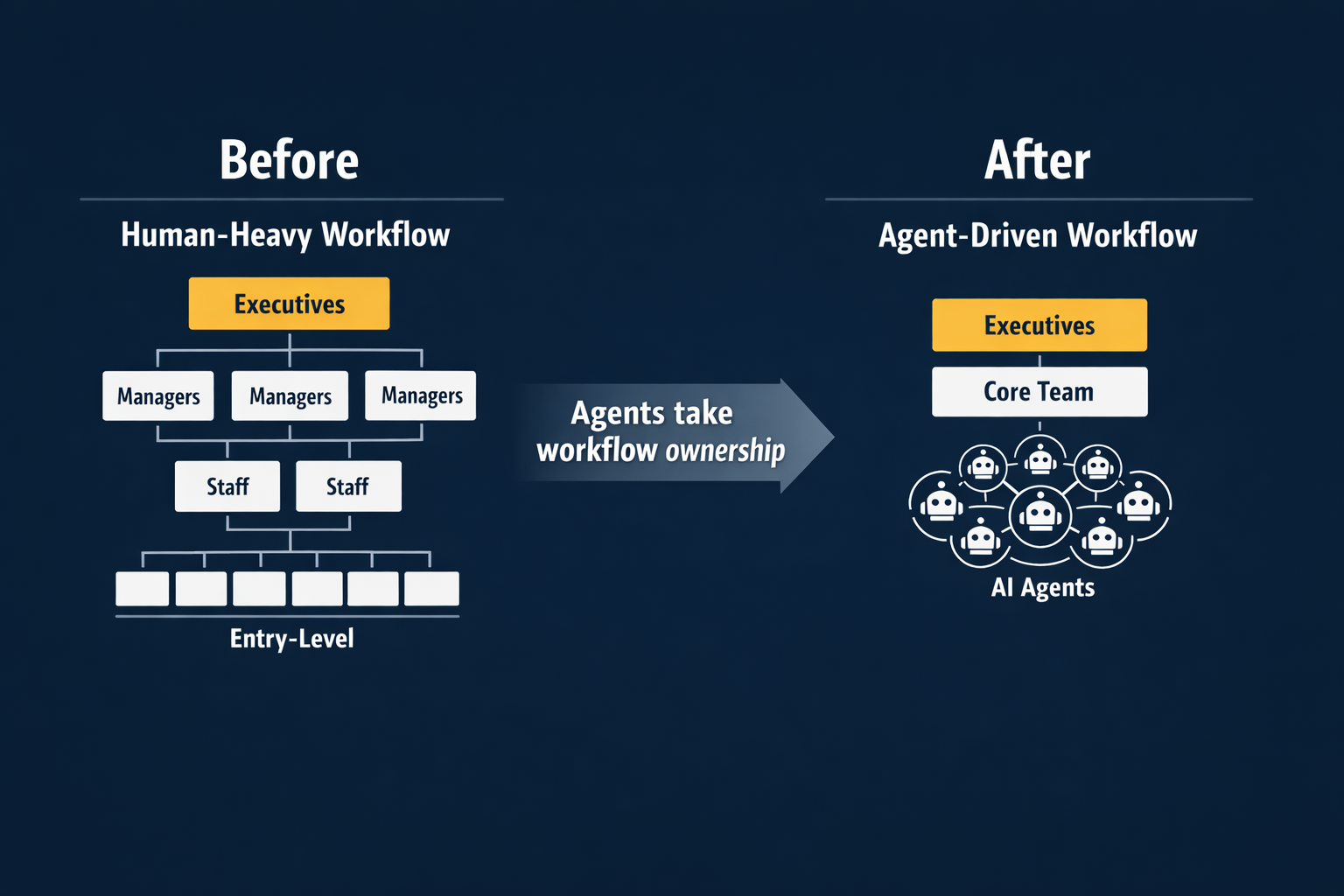
TL;DR
AI does not replace jobs when it becomes smarter than humans.
It replaces jobs when it becomes cheap, local, private, and uncontrollable.
The rise of powerful open-weight AI models that run directly on laptops and phones removes nearly every barrier that once slowed automation. This accelerates job displacement quietly and unevenly, long before layoffs make headlines. The real threat is not sudden replacement, but the silent erosion of roles as AI-augmented workers make others economically unnecessary. Surviving this shift requires changing how you create value — not just learning new tools.
Watch: Why Job Loss Is About to Accelerate
This 6-minute companion video explains why job displacement is accelerating — and why adapting how you create value matters more than learning any single tool.
Why This Moment Feels Different — Even If You Can’t Fully Explain It Yet
If you talk to professionals today — developers, analysts, marketers, project managers — a pattern emerges. People don’t always say “AI is going to take my job,” but they say things like:
They’re working harder than ever, yet feel less secure.
Their output is up, but teams are shrinking.
Roles aren’t being backfilled.
Management keeps talking about “efficiency.”
That unease is rational.
For years, workers were told that AI adoption would be slow and manageable. Companies would need budgets, approvals, legal reviews, and security sign-off. Automation would be deliberate. Workers would have time to adapt.
That assumption is now breaking.
A new generation of AI models — smaller, more efficient, and often open-weight — can now run locally on personal devices. No cloud. No subscription. No API. No logging. No central control.
This is not just a technical milestone.
It is an economic accelerant.
Job displacement speeds up not when AI becomes brilliant, but when AI becomes frictionless.
A Pattern We’re Seeing Everywhere (A Composite Example)
This is not a single company. It is a pattern repeating across industries.
A mid-sized SaaS company has a marketing team of a dozen people. No layoffs are announced. No restructuring memo goes out. Instead, three people quietly begin using local AI models to draft copy, rewrite content, generate variations, and optimize campaigns.
Within a few months, those three are producing more usable output than the rest of the team combined.
Management notices. Projects that once required coordination across multiple roles now move faster with fewer people involved. When a few team members leave voluntarily, they aren’t replaced. Later, budgets tighten and “efficiency improvements” are announced.
The team goes from twelve to four.
No one was fired because “AI replaced them.”
The job simply stopped existing.
This is how displacement happens now.
How Job Displacement Used to Happen (And Why It Was Slower)
Historically, workplace automation followed a top-down path.
New technology moved through layers of friction: procurement, security review, compliance checks, budget approvals, vendor negotiations. Even when a tool could replace human labor, deploying it at scale took time.
That friction mattered. It slowed disruption. It created warning signs. It gave workers leverage and time.
In that world, layoffs were usually intentional and visible. Leadership made decisions. HR prepared messaging. Workers could see the wave coming.
This is the mental model most people still carry when they think about AI and jobs.
It no longer applies.
Visual: AI Adoption — Then vs Now
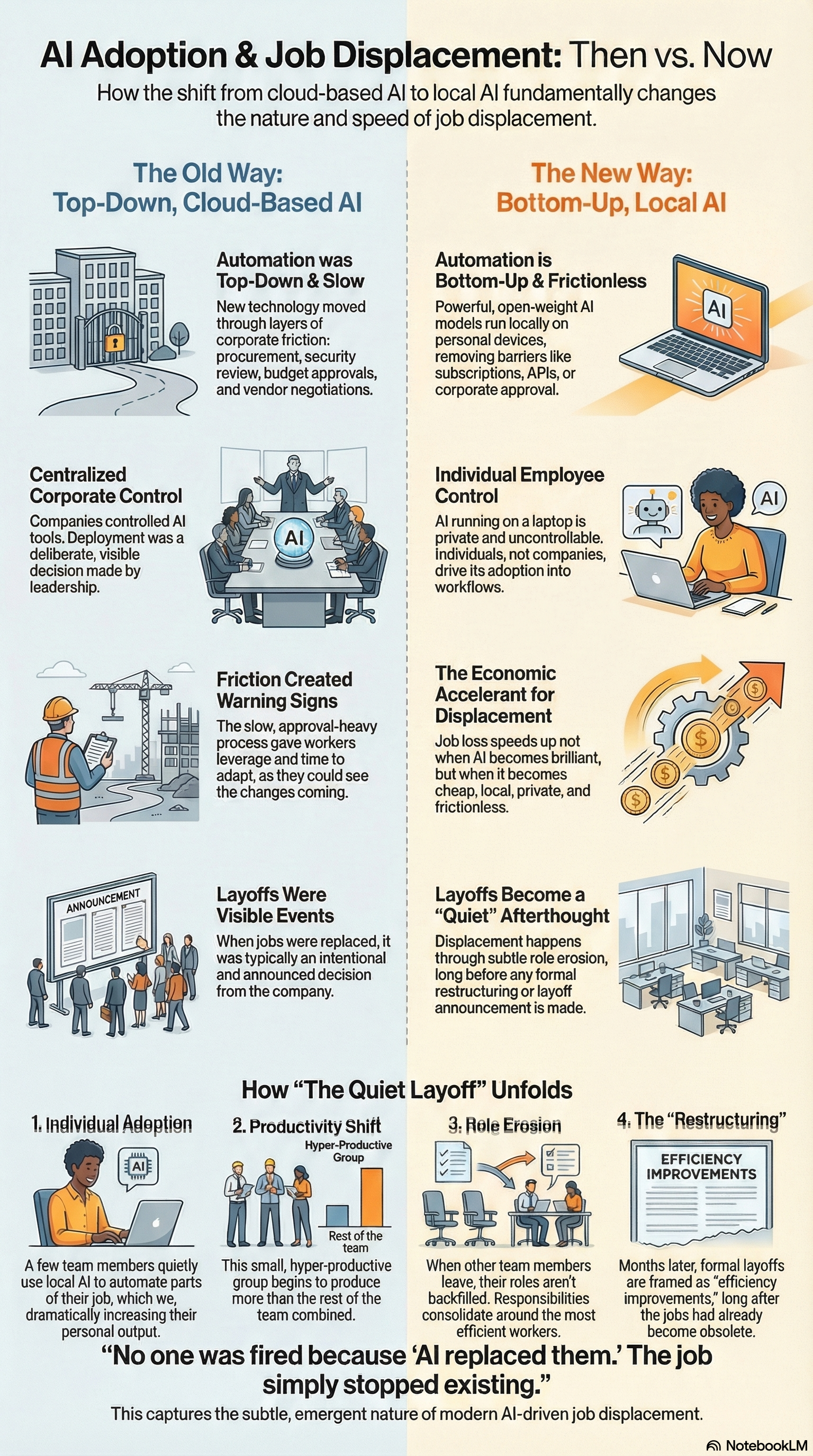
This visual contrasts approval-heavy, centralized AI adoption with today’s bottom-up, local AI usage that accelerates job displacement.
What Changes When AI Runs Locally
When AI runs in the cloud, companies control it.
When AI runs on laptops, individuals control it.
That single shift flips the direction of automation.
Instead of leadership deciding when AI enters workflows, individual workers adopt it privately. They automate parts of their job. They increase output. They do not label this as “automation.” They just look more productive.
Nothing breaks. No policy is violated. No system flags an issue.
From the outside, it simply looks like one person is outperforming others.
By the time leadership notices, the role is already half-obsolete.
The Quiet Layoff: How Roles Disappear Without Anyone Being Fired
Local AI rarely causes immediate layoffs.
It causes something more subtle and more dangerous: role erosion.
Hiring slows. Backfills disappear. Responsibilities consolidate. One person now “handles” what used to require several roles.
Months later, when layoffs happen, they are framed as optimization, restructuring, or efficiency.
From management’s perspective, this looks rational.
From the worker’s perspective, it feels like the ground vanished without warning.
This is why so many people feel anxious without being able to point to a single cause. The displacement happens before the narrative catches up.
Visual: The Quiet Layoff Timeline
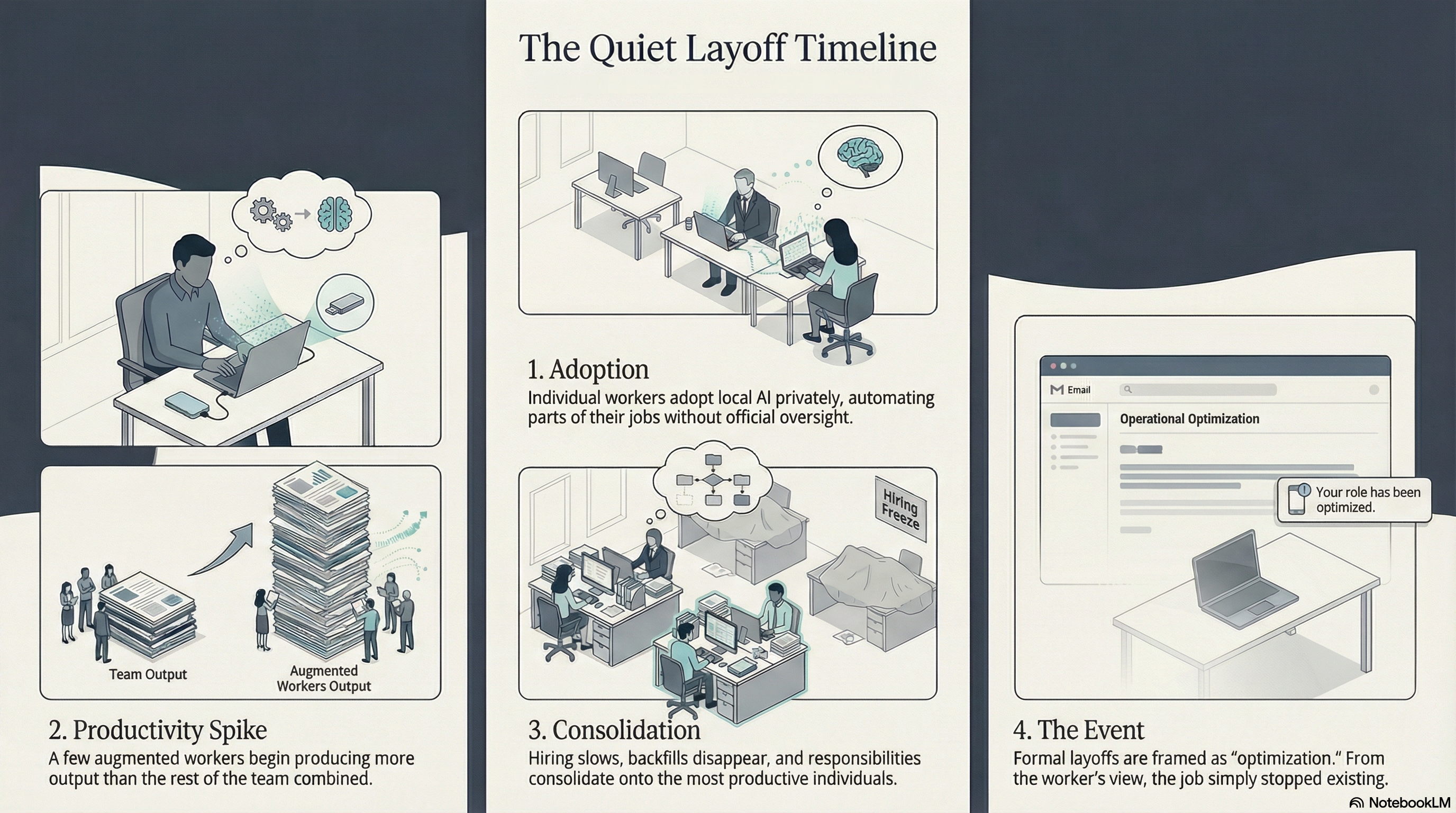
This timeline illustrates how productivity gains from local AI quietly eliminate roles long before layoffs are formally announced.
Why Coding Is the Canary in the Coal Mine
Much of the attention around local AI focuses on coding, and that is not accidental.
Coding is not uniquely vulnerable because it is technical.
It is vulnerable because it is measurable.
When a local AI model can handle a large percentage of coding tasks offline — writing boilerplate, refactoring, debugging, explaining code — productivity differences become undeniable. Junior roles shrink first. Then mid-level roles consolidate. Senior roles shift toward oversight and decision-making.
The same pattern applies to analysts, QA testers, support engineers, content producers, and operations staff.
Coding is simply the most visible example of a broader labor shift.
Why Regulation and Corporate Policy Won’t Save These Jobs
Many people hope regulation will slow AI-driven job loss. That belief assumes AI usage can be centrally controlled.
Local AI breaks that assumption completely.
Offline models on personal hardware have no telemetry, no API calls, and no enforcement point. Even strict corporate policies cannot realistically prevent private local use.
This is not a failure of ethics.
It is a structural reality.
Job protection strategies built around slowing deployment or licensing access lose effectiveness once AI leaves the cloud.
A Quick Reality Check (Read This Carefully)
Before moving on, ask yourself:
If you disappeared tomorrow, would projects stop — or just slow down?
Do people rely on you for judgment, or for execution?
Could a manager describe your value in one sentence?
Is your work defined by outcomes, or by tasks?
If these questions are uncomfortable, that discomfort is information.
Visual: The 60-Second Job Security Reality Check
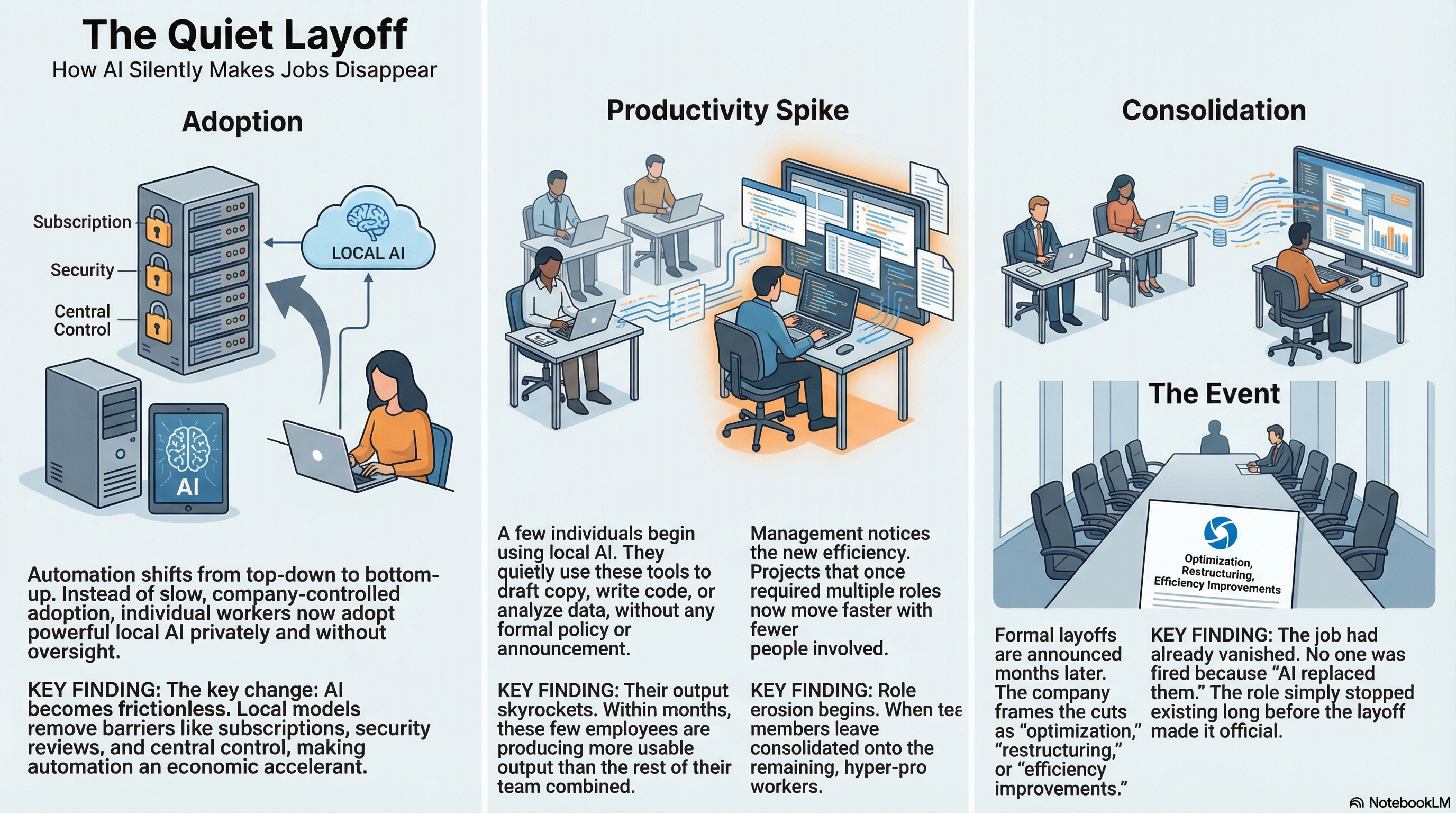
This self-assessment helps readers evaluate whether their role is defined by execution or by judgment and outcomes.
Why “Just Learn AI” Is Patronizing Advice
You’ve probably heard it already:
“AI won’t replace you. Someone using AI will.”
Technically, this is true.
Practically, it is deeply misleading.
Learning AI tools does not protect you if the underlying role no longer requires a human. It shifts the competition, but it does not change the economic outcome.
Telling people to “just learn AI” ignores the real problem: value collapse in execution-only roles.
Survival is not about being faster at tasks.
It is about being responsible for decisions and outcomes that cannot be automated away.
The Survival Shift: How Value Is Being Redefined
In a local-AI world, value moves upstream.
Workers who survive tend to:
- Own decisions, not just deliverables
- Understand systems, not just steps
- Define constraints, not just follow them
- Integrate AI into workflows responsibly
- Take accountability for results
Learning AI is necessary.
Redefining your role is essential.
The Broader Societal Impact: Faster, Uneven Labor Shock
Zooming out, local AI accelerates job displacement unevenly.
Some workers adapt quickly. Others fall behind without a clear explanation. Communities experience disruption without a single villain to blame.
This erodes trust — in employers, institutions, and the idea that effort guarantees security.
The danger is not collapse.
It is prolonged instability.
Conclusion: The Acceleration Is the Threat
AI did not just get smarter.
It escaped.
When automation becomes local, private, and frictionless, job displacement becomes an emergent property of everyday work.
The most dangerous phase is not mass layoffs.
It is the present moment — where roles quietly erode and people feel the ground shifting beneath them without a clear signal of why.
Fear, in this case, is not irrational.
It is information.
And those who recognize what is happening early still have time to adapt.