TL;DR
A normal photo of your child can now be turned into fake sexualized content with cheap AI tools. Your child does not have to post anything risky for this to happen. A school photo, a sports picture, or a family post can be enough. That means the old internet safety rules are no longer enough on their own. Parents and schools need to think less about “bad photos” and more about how any child photo can be copied, changed, and used for harm.
A fake image can still cause real damage. It can lead to bullying, panic, humiliation, and lasting emotional harm. The best response is not panic. It is a smarter plan: reduce unnecessary public child photos, ask schools and teams about their photo policies, talk to your kids about fake-image bullying, and know what to do fast if an image starts spreading.
Watch: Parent Briefing
A normal photo of your child used to feel harmless
It was a school picture. A soccer team photo. A birthday snapshot. A smiling face on a family social media page.
Now that same kind of photo can be turned into fake abuse material by someone using cheap AI tools.
That is the shift many parents still have not fully absorbed.
Your child does not need to post something revealing. They do not need to make a bad choice. They do not need to do anything wrong. The raw material can be a completely normal picture. That is what makes this threat so different from the older internet safety risks parents are used to hearing about.
This is not just an internet scare story. Child-protection groups are already treating AI-generated sexualized images of minors as a real and growing problem. Families and schools are still using old assumptions about photo sharing, but the technology has already changed the risk.
The old advice was simple: teach your child not to post risky content.
That advice still matters. But it is no longer enough.
Now the problem is not just what your child shares. It is what someone else can do with an ordinary photo once they get it.
What changed
The biggest change is that the barrier to abuse got much lower.
A few years ago, changing a photo in a convincing way took more skill, better software, or a lot more time. Now generative AI tools make it easier, faster, and cheaper. That matters because it expands the number of people who can do harm.
This is no longer just a problem involving sophisticated criminals. It can also be a peer problem. A bully. A classmate. Someone in a group chat. Someone who wants to embarrass a child, pressure them, or scare them. Someone who thinks it is funny until the damage is done.
That is a major change. The danger is not locked away in some far-off part of the internet. It can start inside ordinary school life, social circles, and youth communities.
How it works
The process is simple, which is part of why it is so dangerous.
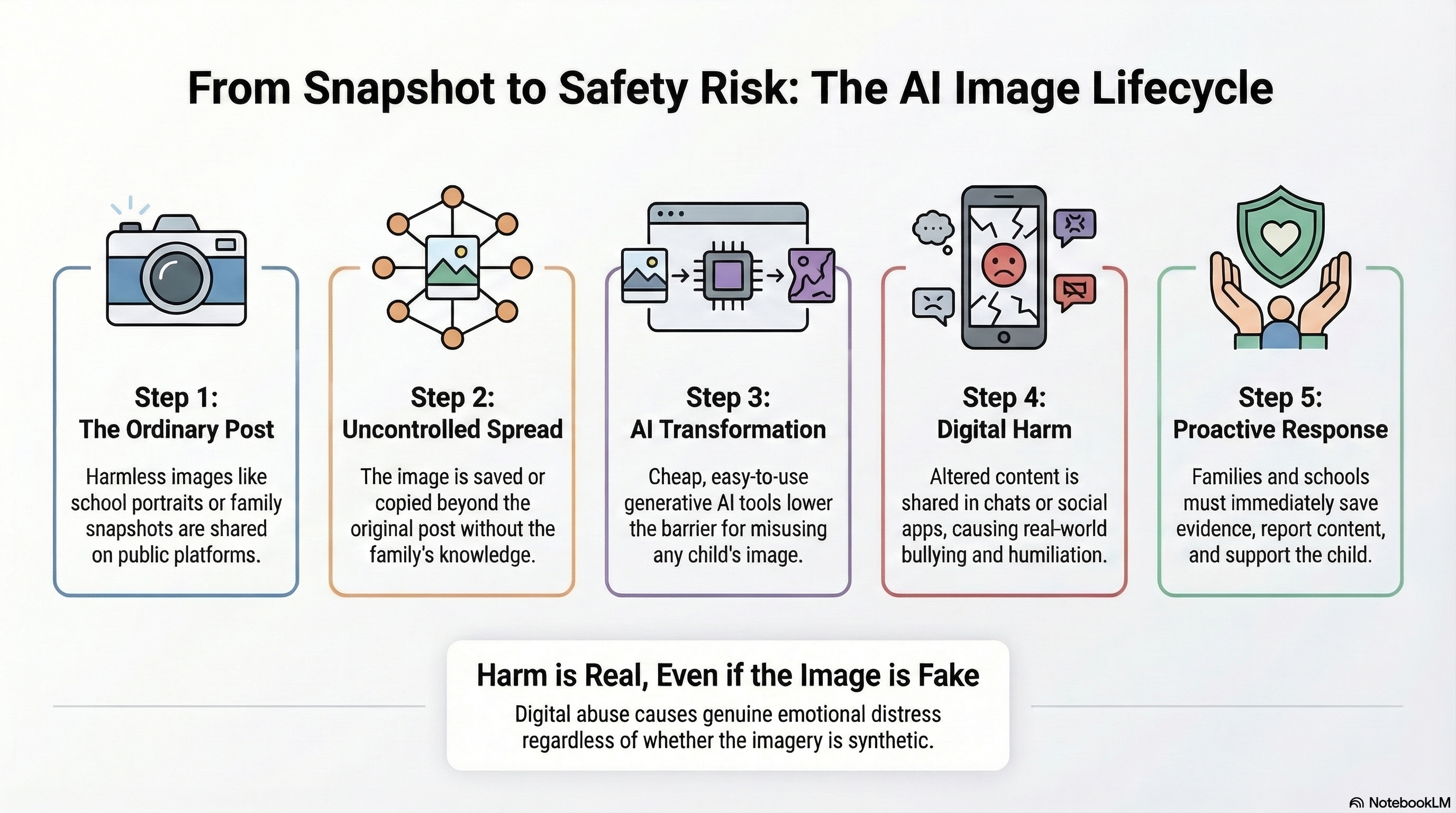
First, a normal child photo exists somewhere. It might be on a parent’s page, a school website, a sports team account, a club page, a family group chat, or another student’s phone.
Then someone copies or saves that image.
Next, they use an AI tool to change it into fake sexualized content.
After that, the fake image gets shared. It may spread in private messages, student groups, social apps, or direct threats sent to the child or family.
By the time adults find out, the damage may already be underway.
That is the part parents need to understand. The problem is not only the fake image itself. It is the speed. Once something starts moving through phones, chats, or social feeds, control drops fast. The child may already be humiliated. Other kids may already have seen it. Copies may already exist on devices you cannot reach.
In plain language, the chain looks like this:
A normal photo gets copied.
AI changes it.
Someone spreads it.
A child gets hurt.
The original photo does not need to be suggestive. It only needs to exist.
Why parents need a new mental model
A lot of internet safety advice still centers on one main message: do not overshare.
That is still useful advice. But it was built for a world where the danger mostly came from what was posted in the first place. The new reality is harsher. A harmless image can be turned into something harmful later.
That means many careful parents are using an outdated mental model. They think, “My child does not post inappropriate things, so this is not really our issue.”
That is no longer true.
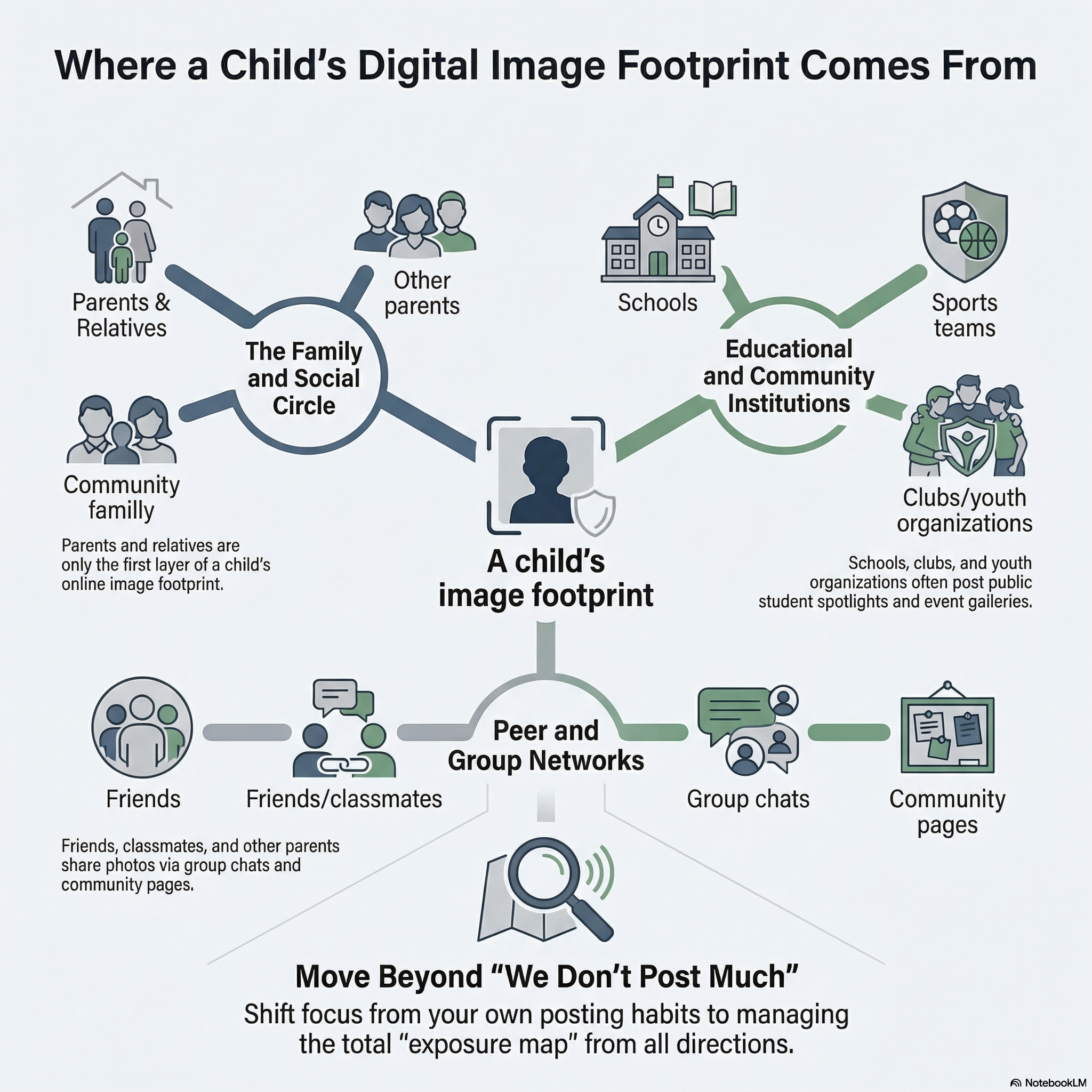
A child can be exposed even if the family is fairly careful. Parents are not the only people creating the child’s digital footprint. Schools post photos. Sports teams post photos. Relatives post photos. Other parents post photos. Friends share pictures. Classmates save and forward things. Group chats create their own little ecosystems of exposure.
So even if you are disciplined about what you post, that does not fully solve the problem.
This is why the comforting line “we do not post much” is no longer enough by itself.
Why fake images still cause real harm
Some adults make a mistake when they first hear about this issue. They think that if the image is fake, then the harm must somehow be less serious.
That is not how it works in the real world.
The shame is real. The fear is real. The bullying is real. The panic is real. The damage to a child’s sense of safety is real. The pressure on the family is real. The disruption at school is real.
A fake image can still tear through a student’s social world. Other kids may not stop to ask whether it was AI-generated. They may only react to the image, the gossip, and the humiliation. Even if the truth comes out later, that does not erase what the child already went through.
That is why this issue belongs in the child safety category, not just the tech category. It is not mainly about clever software. It is about how quickly a child’s life can be shaken by something fake that still lands like a real attack.
Who is most exposed first
Some kids are more exposed than others, at least at first.
Children and teens with bigger digital footprints face more obvious risk. That includes students who are active online, kids whose schools post many public photos, children in sports programs, and teens in social environments where bullying or status games are already common.
But this does not stay limited to the most online families. Once the tools become cheap and easy enough, the risk spreads outward. Ordinary families with ordinary habits also become part of the exposure map.
That is why this issue matters beyond a few edge cases. It is not only about children who are “always online.” It is also about normal families living normal lives in a world where images can now be repurposed in harmful ways.
The school problem is bigger than most parents realize
Schools are in a difficult position because many of their photo practices were built for a different era.
A school might post student spotlights, event galleries, or classroom photos with good intentions. None of that was designed to create harm. But good intentions do not change the new reality. A public image can now become source material.
That means schools may be creating exposure without realizing how much the risk has changed.
The bigger problem is that many schools are not prepared for the response side either. If an AI-generated sexualized image of a student starts circulating, a lot of schools will discover they do not have a clear process. Who handles it first? Who preserves evidence? Who talks to the family? Who determines whether it is a safeguarding issue, a discipline issue, or a law-enforcement issue?
If those answers are unclear during a crisis, the school loses time. And in cases like this, time matters.
Parents should assume that many schools are behind on this issue unless the school has clearly shown otherwise.
What parents should do now
The goal is not to panic and wipe every photo off the internet. The goal is to get more deliberate.
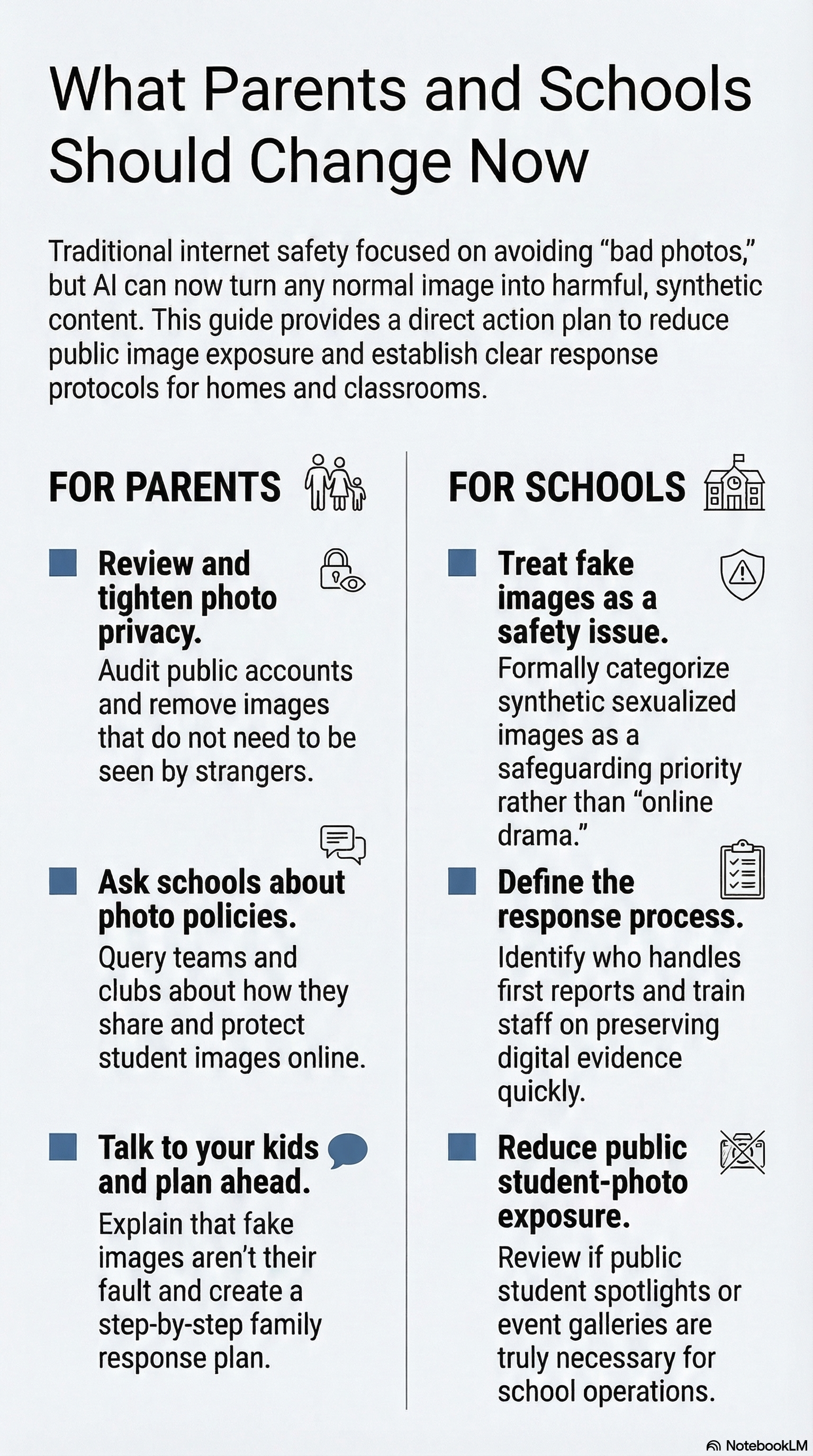
Start by looking at where your child’s photos are public right now. Not later. Not in theory. Look at the actual accounts, team pages, school pages, and family posts. Ask which images truly need to be public and which ones are just there because nobody ever revisited them.
Then ask harder questions outside your own home. How does your child’s school handle public photos? Does the sports league post team pictures openly? Do clubs or community groups use children’s images in public updates? What do grandparents or relatives share that they think is harmless?
You also need to talk to your child in plain language. They do not need a terrifying speech. They need a clear one. Tell them that fake images can be made from normal photos, and if anyone ever shows them something strange, threatening, or humiliating, they need to tell you right away. Kids should know that being targeted by a fake image is not their fault.
Families also need a response plan before they need one. If an image starts spreading, panic will waste time. Decide now what your first steps would be. Save evidence. Take screenshots. Record usernames, platforms, and timestamps. Contact the school if students are involved. Report the content on the platform. Keep notes on who you contacted and when.
The worst time to build a plan is during the first hour of a crisis.
What schools should do now
Schools need to stop treating this as a distant issue.
If a sexualized fake image of a student is circulating, that should be handled as a student safety issue, not brushed off as online drama. The fact that the image is fake does not make the harm fake.
Schools should review how often they post student images publicly and whether those posts are truly necessary. They should also look at whether their media release assumptions still make sense in a world where an innocent image can be turned into something abusive.
More importantly, schools need a clear response process. Staff should know who takes the first report, who leads the response, how evidence is preserved, how parents are contacted, and when outside authorities need to be involved.
Schools also need better language for communicating with families. Many schools still rely on generic digital citizenship language that does not match the current reality. Parents deserve a more honest explanation of what changed and why older safety assumptions are not enough.
A simple checklist for parents
In the next week, review the public child photos on your main accounts. Tighten privacy settings where needed. Ask at least one school, team, or youth group how they handle public photos. Have one calm conversation with your child about fake-image bullying and why they should tell you immediately if something seems off.
Over the next month, go back through older albums and remove what no longer needs to be public. Check what relatives are posting. Look at which outside groups create the most image exposure for your child. Write down a basic family response plan so you are not improvising under stress.
Over time, treat your child’s image footprint as something that deserves ongoing attention. This is not a one-time cleanup. It is a new part of modern parenting.
A simple checklist for schools
In the next week, schools should decide whether synthetic sexualized images are explicitly treated as a safeguarding issue. They should identify who receives the first report and who leads the response. They should also review whether public student-photo posting has become too casual.
Over the next month, schools should update their guidance for AI-manipulated student images, brief staff on evidence handling and escalation, and review how they would communicate with families during an incident.
Over time, they should reduce unnecessary public image exposure, train staff regularly, and treat this as part of modern student protection rather than as a side issue for the communications team.
Your 7 / 30 / 90-day plan
In the next 7 days, parents should review where their child’s photos are public and ask basic questions about school and team photo policies. Schools should identify who owns response if a synthetic-image incident appears tomorrow.
In the next 30 days, families should complete a simple photo exposure audit and create a response plan. Schools should update at least one policy, process, or communication template to reflect AI-generated image abuse.
In the next 90 days, families should make this part of their normal digital safety habits. Schools should move from awareness to system: fewer unnecessary public student photos, clearer escalation, and staff who know this threat is real.
What to do now
Parents do not need more abstract panic. They need a better framework.
The right move is to stop thinking only about “risky photos” and start thinking about image exposure as a whole. Schools need to stop assuming that good intentions around photo sharing are enough. Families need to accept that ordinary images now carry a different kind of risk than they used to.
That is the hard truth underneath this story.
The image did not become dangerous because your child did something reckless. It became more dangerous because the tools changed.
And the families who adapt to that reality sooner will be in a much better position than the ones still using the old rules.
CTA
Download the Family AI Safety Checklist: Child Photo Exposure Audit and use it to map where your child’s image footprint exists, who controls it, and what should change first.
Internal links
- Pillar hub:
/pillars/kids-school - Conversion asset:
/downloads/family-ai-safety-checklist
Media assets
- Hero image:
deepfake-kids-hero-abstract.png - Infographic 1:
deepfake-kids-risk-pathway.png - Infographic 2:
deepfake-kids-attack-surface.png - Infographic 3:
deepfake-kids-response-checklist.png - Video placeholder:
deepfake-kids-parent-briefing.mp4